Geroba Data Technologies: Make the better decisions

Cassandra Token Calculator

Cassandra Token Calculator
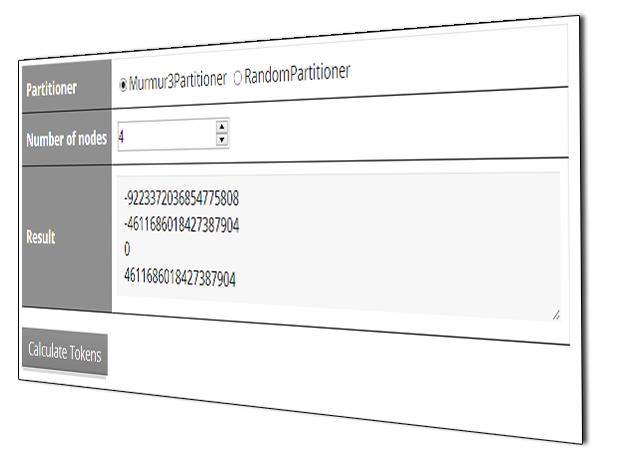
Token Calculator (Screenshot)

A handy Apache Cassandra token calculator for online initial token calculation with RandomPartitioner and Murmur3Partitioner

When creating a Cassandra cluster and not using virtual nodes that were introduced in version 1.2 (and are not fully supported by OpsCenter yet), you need to define the token range each individual cluster node is responsible for. If you set up Cassandra Clusters from time to time (like I do), this online calculator can be quite handy for you.

Just enter the amount of nodes you want to have initially and the partitioner (either RandomPartitioner or Murmur3Partitioner which is default in Cassandra 1.2+):

Cassandra Token Calculator

Partitioner
Number of nodes
Result
Calculate Tokens

Note: This implementation uses the BigInteger JavaScript Library by Silent Matt.

Explanation of token calculation

The token calculation is basically a function that divides the whole token range into equally sized subparts. For the RandomPartitioner, Cassandra offers a tool to calculate the partitions, for Murmur3, a Python script is provided:

The following two tabs change content below.
Gernot R. Bauer is the founder of Geroba Data Technologies. With a strong technological background in informatics, mathematics, machine learning and algorithm design, Gernot knows that the base for good business and risk management decisions resides in the quality of the underlying data.
 
Comments

Everything is very open with a clear clarification of the challenges.
It was definitely informative. Your website is very helpful.
Thank you for sharing!

The breakdown of the discussion on geroba in this post was fascinating. Reading up on geroba provides a refreshing creative break while I’m developing Sprunki Sbrunga.

I appreciate the clear explanation of how the token range gets divided into equal subparts. It’s a refreshing change of pace from my usual work on Name 100 Women, where I focus on games and memory challenges instead of database clustering. The distinction between RandomPartitioner and Murmur3Partitioner was something I hadn’t thought about before. Thanks for putting together such a useful resource.

The explanation of how tokens divide the range into equally sized subparts was really clear. It’s a nice change of pace from what I usually work on — running Baby Gender Predictor is all about fun, lighthearted content like Chinese and Mayan gender prediction methods for baby shower entertainment. But tools like this Cassandra calculator remind me why I enjoy diving into technical topics too.

This token calculator looks like a lifesaver for anyone setting up Cassandra clusters manually — dividing the token range into equal subparts is exactly the kind of detail that can save hours of headaches. Reading through this kind of technical deep-dive is a refreshing change of pace from my usual day-to-day work on Country Draw, which is all about map drawing and geography games. It’s nice to occasionally step into a completely different tech world.

I really appreciate the clear breakdown of how the token range gets divided into equally sized subparts for both RandomPartitioner and Murmur3Partitioner. Running Tap and hold keeps me busy with visual effects for social media, but I always enjoy reading about clever technical tools like this one. It’s a refreshing change of pace from image editing to see how mathematical approaches solve database scaling problems.

I found the explanation of how the token range gets divided into equally sized subparts really helpful — it’s the kind of clear breakdown that saves so much time when setting up a cluster. Reading technical deep-dives like this is a nice mental shift from my usual work on AI Kissing Generator, which is all about using AI to turn photos into fun kissing animation videos with no sign-up or editing skills needed. Still, it’s always interesting to see how different tools solve their own unique problems.

The breakdown of how RandomPartitioner and Murmur3Partitioner divide token ranges is actually pretty clever. I spend most of my time building personality tools at Omegaverse Quiz, but I’ve always appreciated well-designed utility pages like this one. It’s a nice reminder that good information design matters, whether you’re dealing with database tokens or fictional mate matching.

Good thing you highlighted the note about virtual nodes since I still maintain clusters running on pre-1.2 setups where manual token calculation is essential. The fact that this tool uses BigInteger in JavaScript instead of relying on the Python scripts makes it way more accessible for quick calculations. I always appreciate practical tools like this — spending time building infrastructure scripts over at Robin, I know how much of a headache manual token ranges can be.

I appreciate how the article breaks down the difference between RandomPartitioner and Murmur3Partitioner for token calculation — it’s easy to gloss over that distinction when you’re setting up a cluster under pressure. While my days are usually spent evaluating free AI video generation tools on AI Video Generator Free, I find myself returning to posts like this whenever I need to refresh my understanding of infrastructure fundamentals.

Love that this tool saves you from manually crunching token ranges for RandomPartitioner vs Murmur3 — way easier than writing a Python script every time. I spend most of my days analyzing facial harmony and visual proportions over at PSL Rating, so it’s a nice refresh to read something this cleanly technical. Thanks for putting it together!

Leave a Reply